

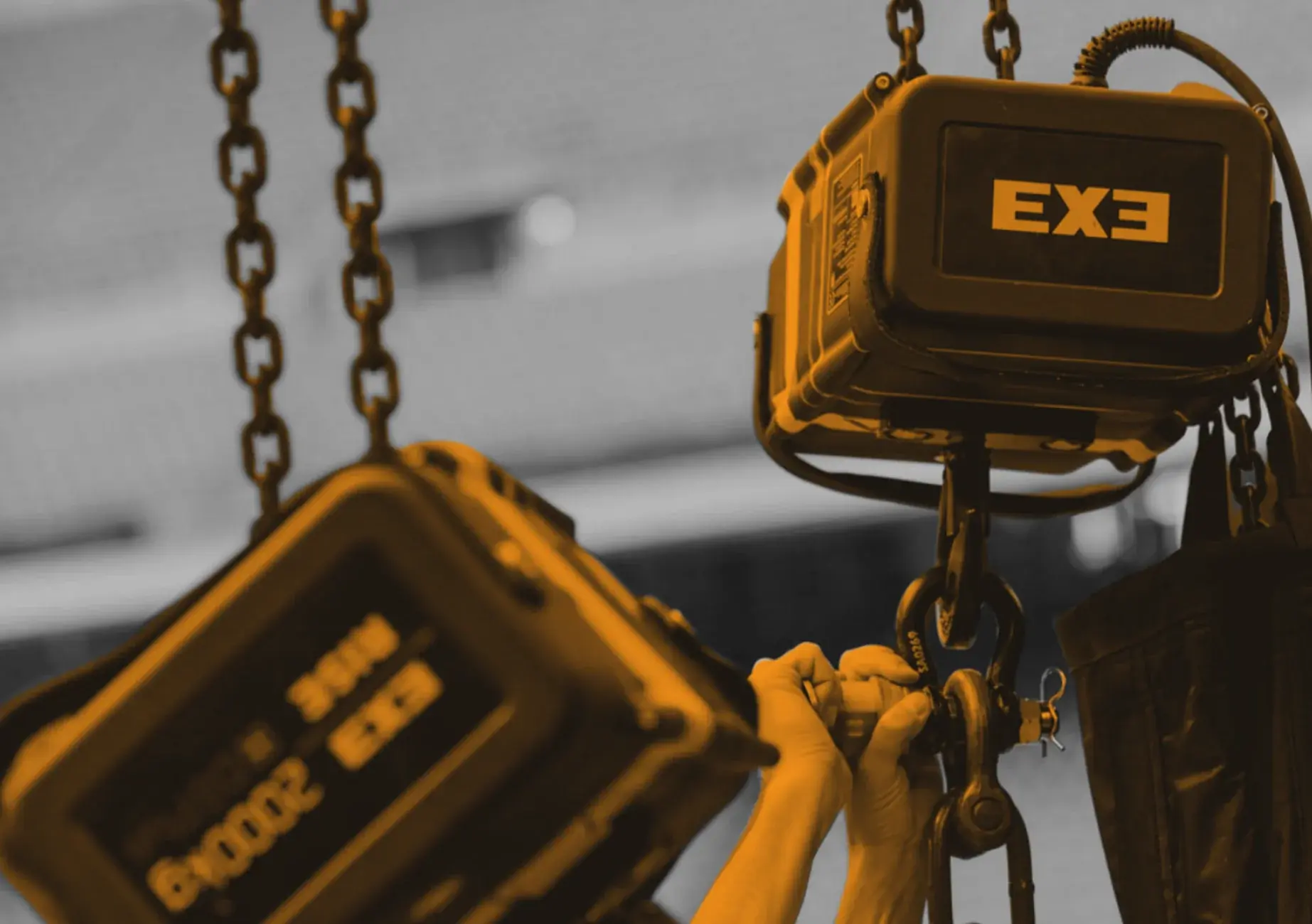

The controller, not the motor, decides how safely a hoist behaves. From the outside, most look identical.
Article · Rigging
Updated 12 May 2026
Rigging
Hoist control
5 features of a safe, compliant hoist controller.
Two hoist controllers can look identical on the outside and behave very differently when it comes to safety. Here is what matters long before you press GO.
Features beat price. The controller governs phase tolerance, interlocks, the E-Stop, feedback and support.
Phase detection, hoist monitoring and interlocks, a compliant E-Stop, clear feedback, and documentation and support.
Atlas Basic, Pro and Smart. Designed, built and supported in Australia.
A safe controller protects people first, equipment second, and the show always.
What happens at the motor is only as safe as the controller driving it.
From the outside, most fixed-speed controllers look identical. Same buttons, same case, same cables. That is where venues get caught out, because inside those boxes the difference between a safe controller and a risky one can be significant.
A controller is not a switchboard for hoists. It is the brain of the system. Across schools, community theatres, rental companies and commercial venues we see the same assumption: the unit powers on, so people take it as compliant. Look closer and the story can change quickly. A controller decides far more than whether the motor turns. It governs:
- How safely the hoists operate
- How well the system tolerates wiring and phase issues
- Whether it meets Australian safety requirements
- How easily faults can be diagnosed
- How reliably it performs under real conditions
These are not optional extras. They are the fundamentals of safe lifting, and they are what separate a compliant, performance-ready controller from a look-alike.
Phase detection and phase alignment.
Three-phase power is not consistent across venues. Plug into a different distro, generator or building and the rotation can flip. Without phase awareness, a controller can energise the hoists with reversed rotation, sending a load up when the operator presses down and bypassing limits set for the original direction. That is not an inconvenience. It is dangerous.
A safe controller makes the rotation predictable. Look for one of two things:
- Automatic phase-reversal detection that holds movement until rotation is corrected
- Or a clear, labelled manual phase correction on the input side
Either approach keeps behaviour predictable when power sources change or operators rotate through a show. Our Atlas controllers carry automatic phase detection across the range.
Hoist monitoring and safe interlocks.
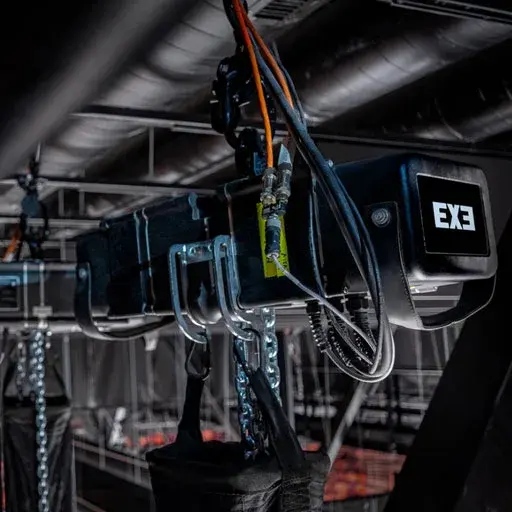
This is one of the most important, and most misunderstood, safety functions in a controller. A compliant unit verifies the essential hoist signals before it allows movement, so it cannot energise a hoist that is not connected, not healthy, or not in the right state. A safe system should ensure:
- Every required hoist signal is present before motion - thermal OK, brake OK, limit circuit closed
- No power reaches a hoist if any safety signal is missing
- An unexpected signal triggers a safe stop
- The operator cannot override or bypass the interlocks
When the interlocks work, the system refuses to move under unsafe conditions. That means fewer near-misses, fewer damaged hoists, and far less risk of uncontrolled motion.
A compliant emergency stop.
Not all emergency stops behave the same, and in lifting the stakes are higher. Some low-cost controllers only drop power when you hit the mushroom. It looks similar on the surface, but it is not the same level of protection, and it may not meet Australian requirements. A compliant E-Stop uses:
- Dual-channel E-Stop circuitry
- A safety-rated relay suited to the application
- Proper isolation of the control voltage
A compliant E-Stop shuts the system down safely and predictably, without creating new hazards. If the safety category or rating is not stated on the spec sheet, treat it as not engineered.
Clear feedback and operator indicators.
When operators work quickly during bump-ins, resets or touring rig changes, clarity matters. A controller that hides faults behind one blinking light forces the crew to guess. Useful feedback includes:
- Direction indicators
- Fault indicators
- Phase status
- Active channel indicators
- Encoder or load information where appropriate
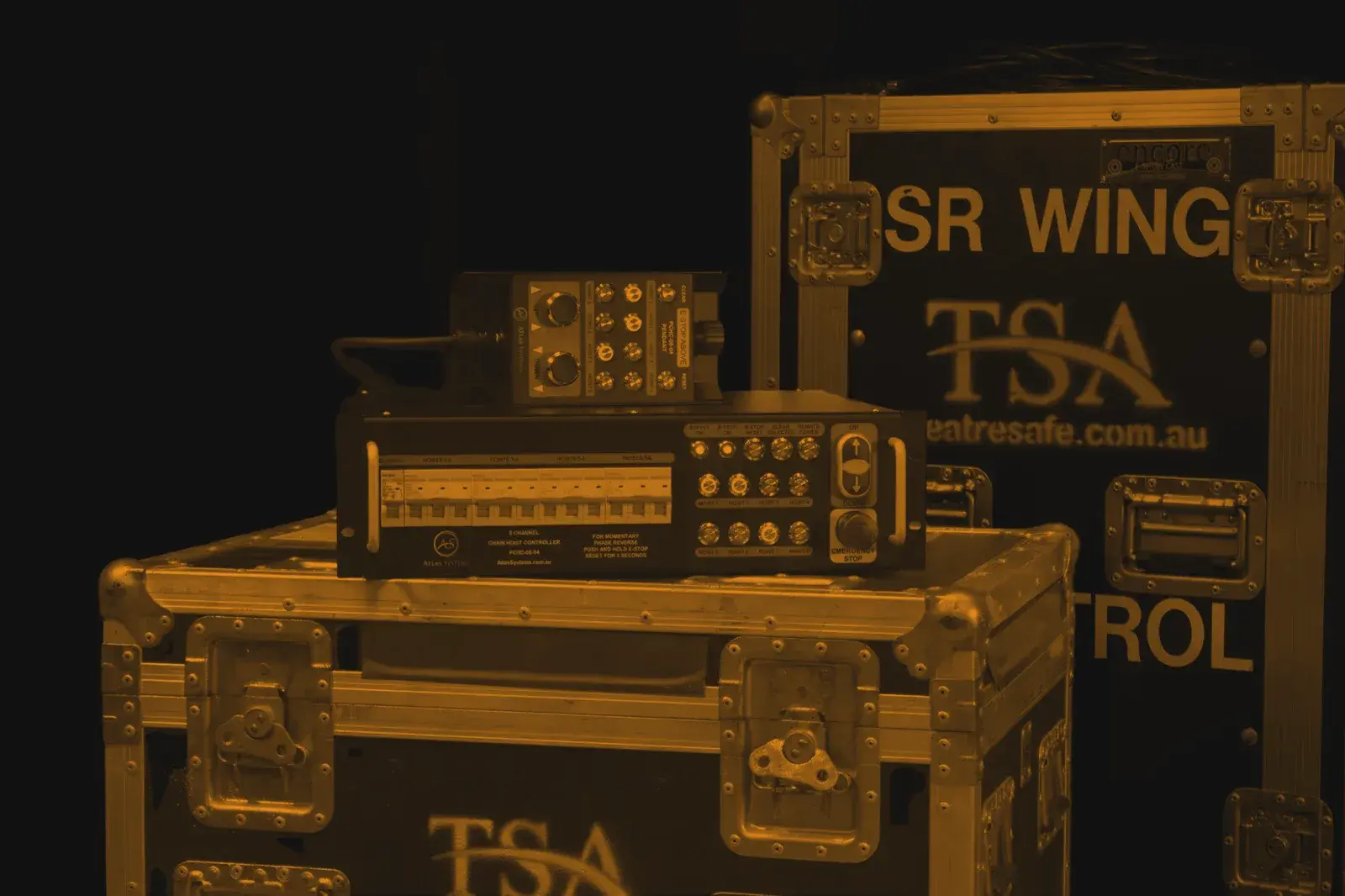
Clear feedback supports safer operation, faster troubleshooting and cleaner handovers between crews.
Documentation, warranty and local support.
A safe controller is not judged only on day one. It is also about how well it can be serviced, repaired and supported across its whole life. A reliable controller includes:
- Installation and setup guidance
- Service and maintenance support
- A meaningful warranty
- Local technicians who can repair the unit
This is where many imported OEM controllers fall short. Without local documentation, parts or support, small issues become major problems. Australian-designed controllers are generally easier to maintain, because they are built for Australian power, conditions and venues.
Safe, compliant and built to last.
Get these five right and you have more than a unit that powers on. You have a system the whole venue can rely on.
Safety
Performers, operators and crew protected first.
Compliance
Aligned with Australian standards and audit expectations.
Reliability
Holds up through shows, changeovers and daily use.
Usability
Clear control that reduces mistakes and downtime.
Longevity
Built to deliver value across its whole service life.
Designed for theatres. Supported in Australia.
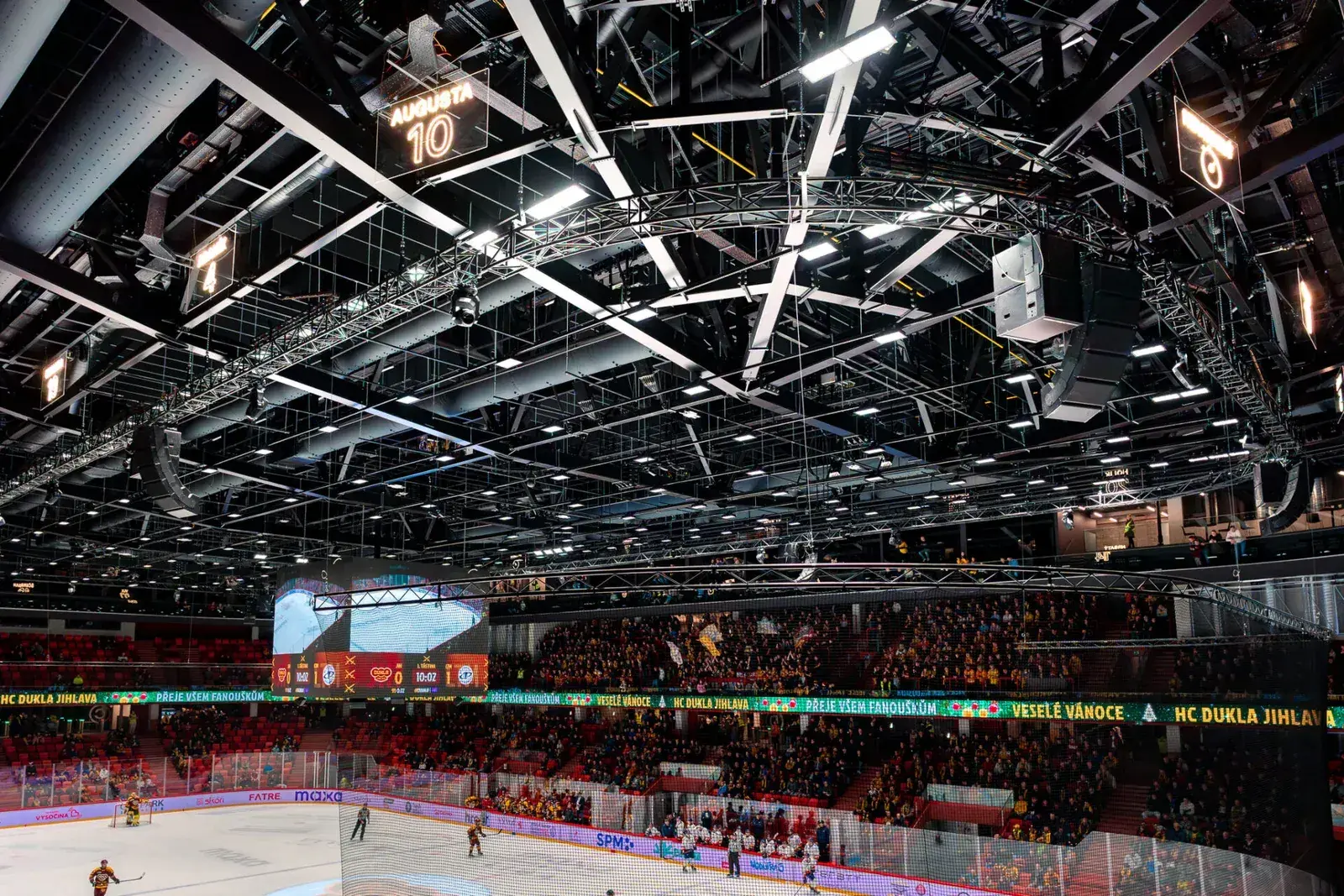
Atlas hoist controllers were developed through ongoing work with technicians, venue operators and touring crews across Australia. They carry the features above because they were built in response to real problems on real rigs: designed and manufactured in Australia, tested in live theatre, and supported locally by our team. The range runs from Basic to Pro to Smart, with a Toggle variant for per-channel direction.
Four models. One safety chain.
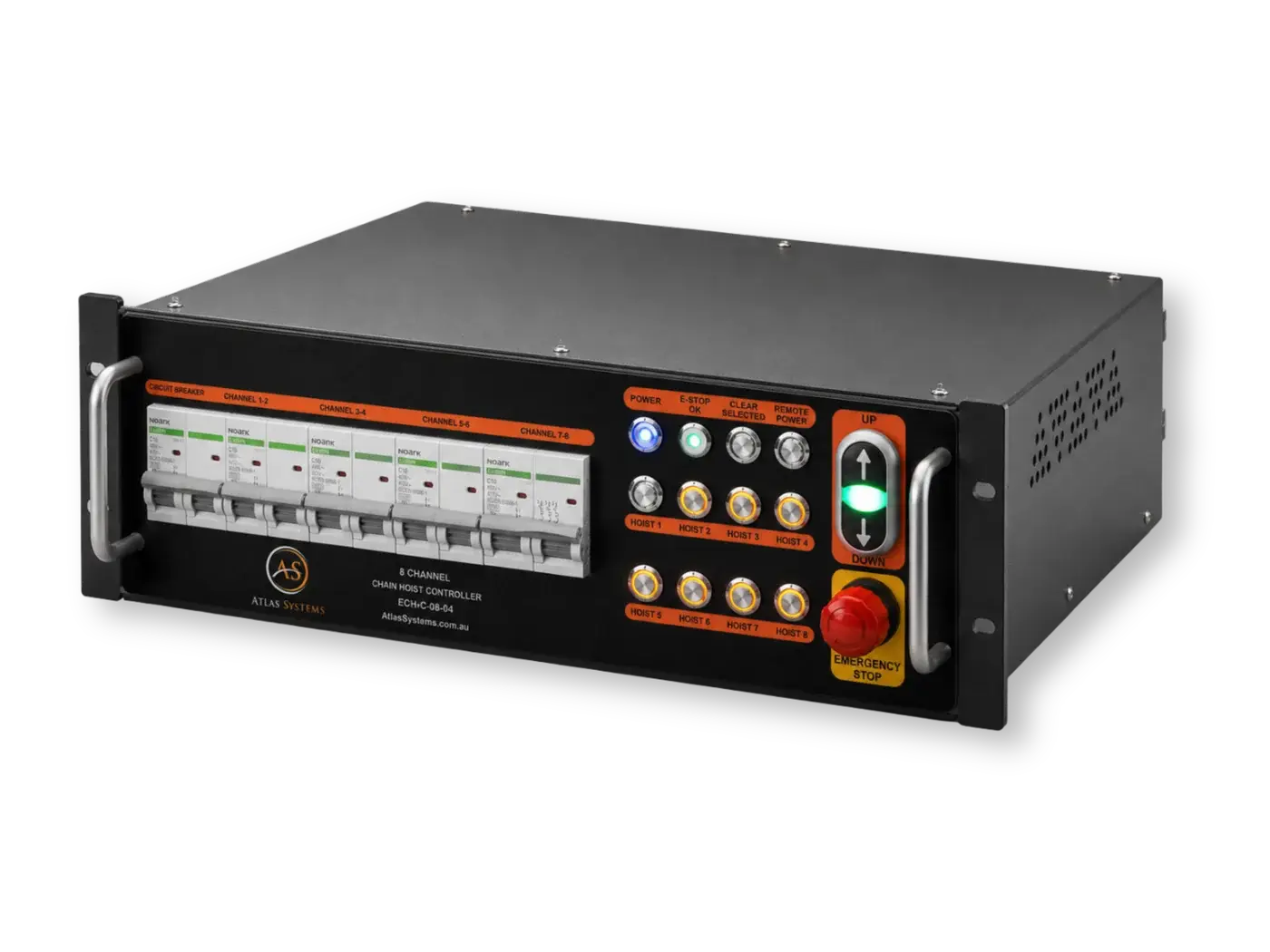
ECHC · Fixed-speed
Basic
4 to 16 channels, manual phase, lightweight chassis. Schools, hire stock and smaller venues.
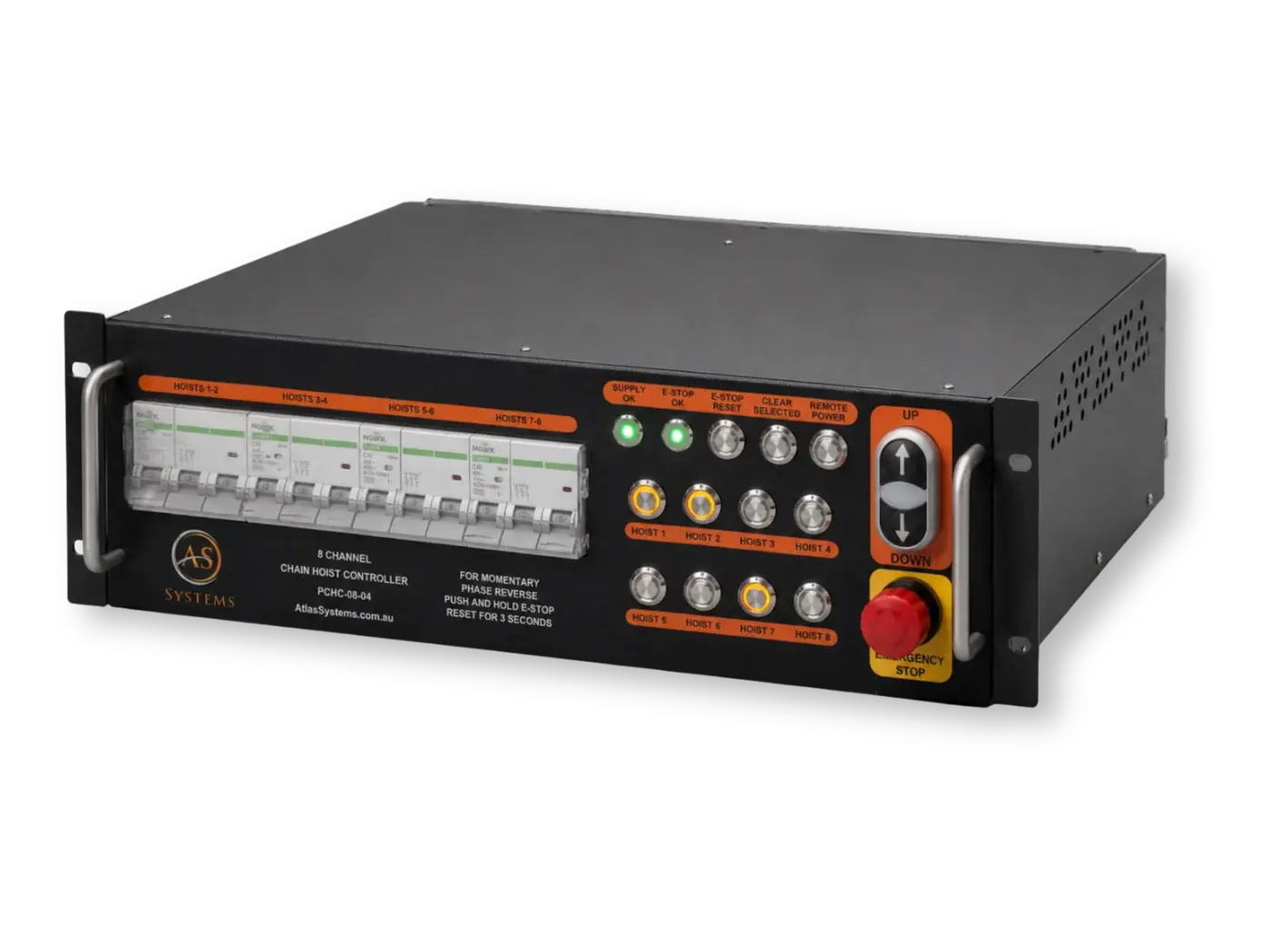
PCHC · Position-ready
Pro
8 to 24 channels, auto phase detection, Bump Mode and an E-Stop designed to AS 4024 Category 3 (SIL2).
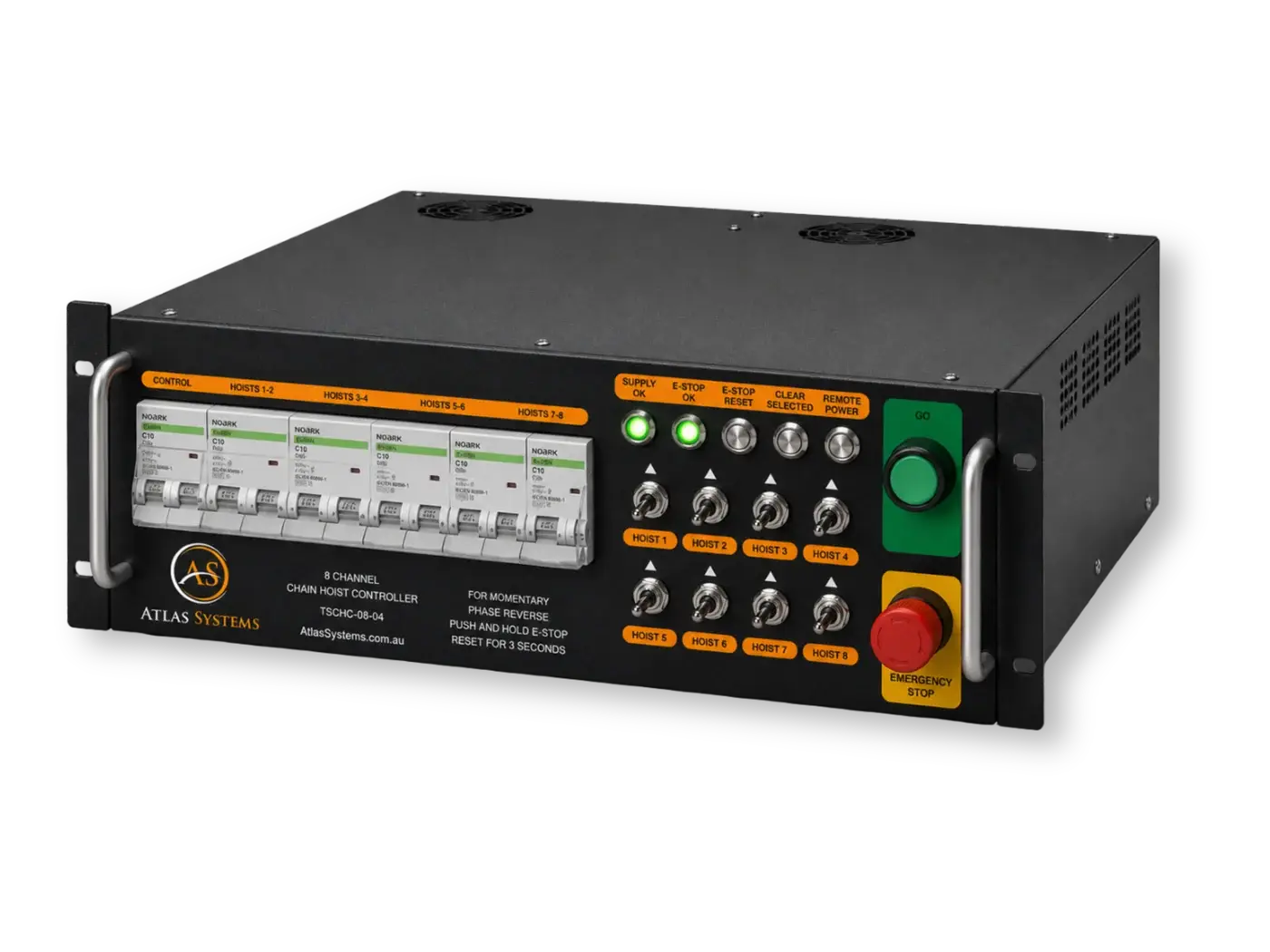
TSCHC · Per-channel
Toggle
8 channels, each latching up or down on its own. Multi-direction scene moves and complex hoist plots.
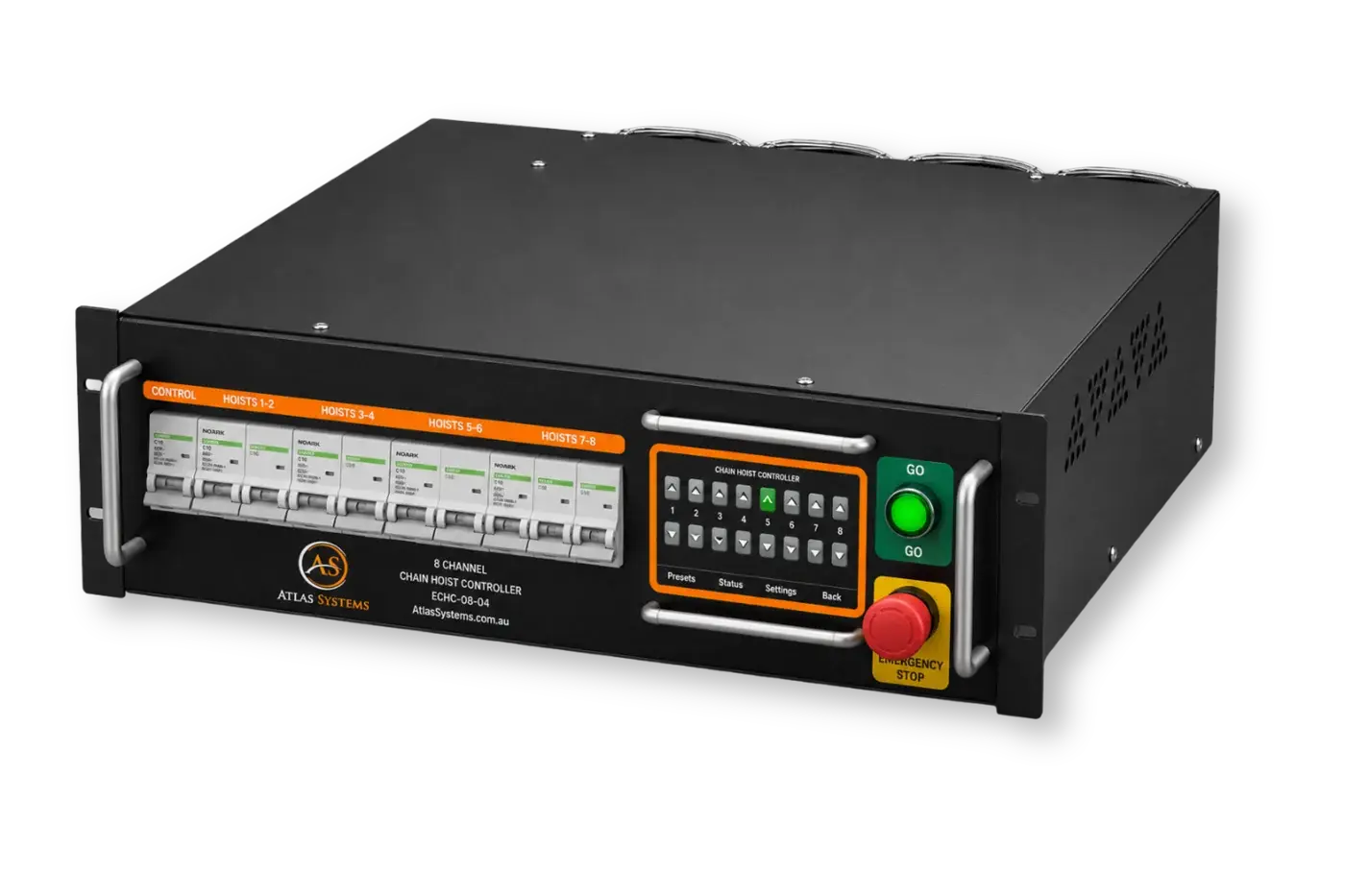
SCHC · Monitored
Smart
Touchscreen with optional encoder and load-cell modules. Position memory, live load, networks up to 12.
Touring crews land on Pro most often. Basic for schools, Toggle for multi-direction moves, Smart for cue-driven rigs. Every model shares 24V SELV control and Wieland 6-pole connectors, so you can mix them on one system.
A hoist controller is not a box with buttons. It is the backbone of your lifting system and one of the most important tools for keeping people and equipment safe. If you want help choosing a safe, compliant controller for your venue, our rigging team is here.
Ready to spec a controller you can trust?
Explore the range
Atlas hoist controllers.
Basic, Pro, Toggle and Smart. 24V SELV control, 4 to 24 channels, Cat 3 E-Stop. Designed and built in Australia.
Browse Atlas controllers The wider rigFlying, lifting & rigging.
Chain hoists, controllers, consumables and rigging hardware. Specified, supplied and supported under one roof.
Explore rigging at TSA